

Last Updated: November 10, 2026
Quick Summary
Getting started with daily planning means deciding, even briefly, what matters most today so your attention goes where you choose before the day pulls it away. Begin with a simple tool and one priority, and keep the plan small enough to use on a tired day. Expect interruptions and build the habit gradually.
- Begin with one planner or notebook and one priority for your first day.
- Write fixed routines like meals, naps, and bedtime before adding anything else.
- Use a five-minute brain dump to empty your mind onto the page.
- Sort tasks into must, should, and could, and choose just one must.
- Review your first week and adjust the template to fix missed days.
Table of Contents
- Why Daily Planning Helps When Your Days Feel Full
- Choosing a Daily Planning Template That Fits Your Life
- How to Plan Your Day at Home with Small Children
- How to Plan Your Day to Be Productive Without Overloading It
- How to Start a Daily Planner in Your First Week
- When a Plan Falls Apart: Recovering Without Guilt
- Your Next Step: Set Up Tomorrow's Plan Tonight
- Frequently Asked Questions
Why Daily Planning Helps When Your Days Feel Full
Getting started with daily planning can feel like one more thing on a long list. But for many mothers, a simple plan for the day brings a little more calm to busy hours. At Bloom Mama Collective, we believe you deserve a rhythm that supports you, not one more demand on your time.
Daily planning is the habit of deciding, even briefly, what matters most today. It is not about filling every minute. It is about knowing where your attention goes before the day pulls it away.
Many mothers feel the most overwhelmed when they are tired. Without a plan, each small request feels like an emergency. With a plan, you can see the day in one place and choose what comes first.
Here is what daily planning can help with:
- Fewer decisions made in the middle of stress
- A clear sense of your top one or two priorities
- Space to notice what you actually have energy for
- A gentle way to return to yourself at the end of the day
You do not need a perfect system to start. A few minutes with a pen and a page is enough.
Choosing a Daily Planning Template That Fits Your Life
Getting started with daily planning is easier when you pick a template that matches your season. A busy toddler schedule needs something different from a planner for a side business. The right template is the one you will actually use on a hard day, not the one that looks best on Instagram.
Before you compare templates, answer three questions honestly:
- Where does your day usually fall apart? If it is forgetting things, you need a capture tool (a brain-dump area or a notes app). If it is overcommitting, you need a prioritization prompt. If it is losing track of time, you need a simple schedule grid.
- How much energy do you have for planning? A template that takes twenty minutes to fill out will be skipped when you are tired. Look for one that takes five minutes or less on a bad day.
- Do you prefer paper or digital? Paper can feel calmer for many people, but it does not send reminders. Digital tools send alerts and sync across devices, but they can pull you into notifications. Choose based on which failure mode you can tolerate.
Here is a simple decision guide for beginners:
- If you forget tasks often: Choose a template with a prominent brain-dump area and a short priority list.
- If you feel overwhelmed by long lists: Choose a template with space for only three priorities and a "later" list. Avoid planners with hourly grids, they invite overplanning.
- If your schedule is unpredictable (shift work, caregiving, freelance): Choose a template organized by parts of the day (morning, afternoon, evening) rather than exact times. Leave blank space for interruptions.
- If you struggle with executive function or variable energy: Choose a template with a simple "must / should / could" sorting area and a place to note your energy level.
Many mothers find it helpful to start with a free printable or a plain notebook for one week before buying anything. This lets you test whether you actually use a schedule grid or just need a priority list. If you are not sure where to begin, try a free template for one week. Then decide whether you want something more detailed.
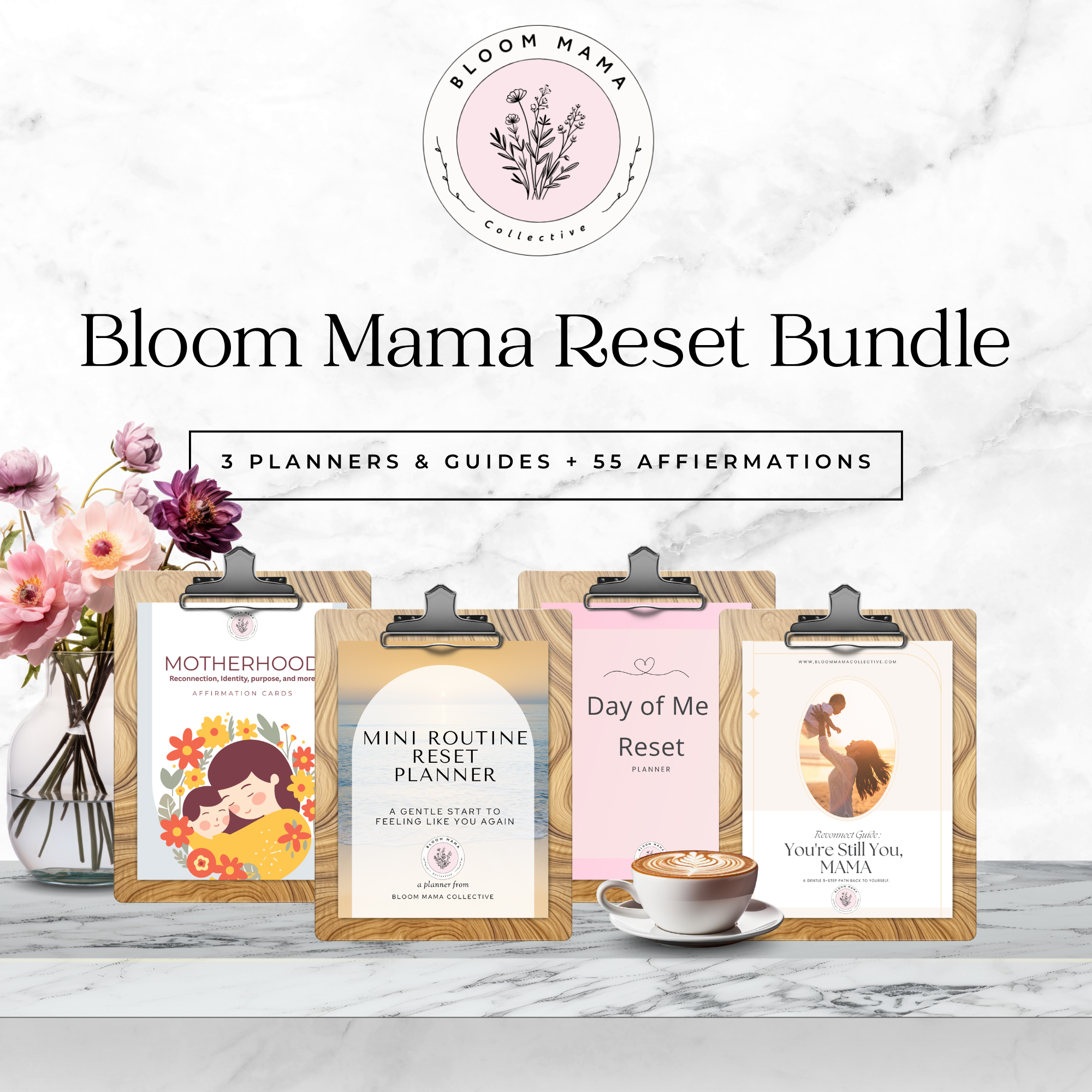
The Bloom Mama Reset Bundle includes printable and fillable planners designed for busy moms in real seasons of motherhood. It offers guided reflection and a simple routine reset for trying daily planning.
Before you pick a template, it helps to know which problem it needs to solve. The options below match each common failure mode to the template type that suits it.
| If your day… | Look for… | Avoid… |
|---|---|---|
| Falls apart from forgetting things | A brain-dump area or notes app | Long task lists with no capture space |
| Gets overcommitted | A prioritization prompt | Planners that encourage many priorities |
| Loses track of time | A simple schedule grid | Grids that invite overplanning |
| Is unpredictable (shift work, caregiving, freelance) | Morning, afternoon and evening sections | Fixed exact-time blocks |
| Brings variable energy | A must / should / could sort and energy note | Templates that take twenty minutes to fill |
How to Plan Your Day at Home with Small Children
Planning your day at home with small children is different from planning at an office. Interruptions are part of the picture, so your plan should leave room for them.

A mother sitting at a kitchen table with an open planner and a cup of tea while a toddler plays nearby on the floor
Start with the things that cannot move: meals, naps, and bedtime. Write these down first. Then add one or two goals that you would like to complete, even if they happen in short pieces.
Try this simple approach:
- Write your fixed routines in pencil
- Choose one task you can finish in ten minutes
- Pick one small thing just for you, such as a short walk or a quiet cup of coffee
- Leave blank space so the day can breathe
A common mistake is planning in hour-long blocks. Children do not follow schedules, so shorter, flexible notes work better. Think in parts of the day, not exact times.
How to Plan Your Day to Be Productive Without Overloading It
Productive days are not the same as full days. Many mothers try to fit everything onto the page and end up feeling like they failed before lunch.
Start by asking one question: what would make today feel like a good day? Write the answer in a few words. Then choose the tasks that support that answer.
A practical method:
- List everything on your mind
- Circle the one or two items that matter most today
- Move the rest to a "later" list
- Plan the day the night before if you can, or in the morning if not
This approach keeps your list realistic. It also gives you permission to leave some tasks unfinished without guilt.
Watch out: planning too many priorities is the most common reason a daily plan gets abandoned. If everything is a priority, nothing is.
How to Start a Daily Planner in Your First Week
Starting a daily planner in your first week works best when you keep it small and expect interruptions. Your goal is to build a habit, not to plan perfectly. This plan builds in recovery from the start.
Day 1: Choose one tool and one priority. Pick a single planner, template, or notebook. Fill in only today's date and one priority. Do not add a schedule yet. The goal is to open the tool and write one thing.
Day 2: Add your fixed routines. Write down meals, naps, and bedtime, the things that cannot move. Notice how much of your day is already spoken for.
Day 3: Practice the brain dump. Set a timer for five minutes and write down everything on your mind. Do not organize it yet. The brain dump is a capture tool, not a to-do list. If you feel calmer after emptying your head, you are doing it right.
Day 4: Sort into must / should / could. Take your brain dump and mark one item as must, two as should, and the rest as could. This is your first real prioritization exercise. Watch out: if everything feels like a must, you are not sorting, you are copying.
Day 5: Add one small self-care task. Choose something that takes ten minutes or less and is just for you, a short walk, a quiet cup of coffee, five minutes of prayer or reflection. Put it on the plan as a real task, not an afterthought.
Day 6: Review and adjust. Look back at the week. Ask three questions: Did I open the planner every day? Did the plan help me feel calmer or more stressed? Did I finish my must tasks?
Day 7: Measure and celebrate. A simple way to measure whether the method is working is to check three things: your completion rate on must tasks (aim for a realistic share of your must tasks), your stress level when you look at the plan (lower is better), and how accurate your schedule was . Celebrate that you showed up, even if the week was messy.
If you miss a day or the whole week falls apart, do not start over from Day 1. Pick up at the next day's step. The sequence is a guide, not a test. A mother who plans two days out of seven in week one is still building the habit.
If you want guided support for this first week, the Bloom Mama Reset Bundle includes a three-day ritual reset and a seven-day habit tracker.
When a Plan Falls Apart: Recovering Without Guilt
Some days your plan will fall apart. A child gets sick, a deadline shifts, or you simply run out of energy. That does not mean daily planning is not working for you.
When a plan collapses, try these steps:
- Pause and take one slow breath
- Look at your top priority and ask if it still matters today
- Cross out what is no longer possible
- Write one small thing you can still do
Mama, you are not failing because the day went differently than you planned. Your effort still counts. The purpose of a plan is to support you, not to judge you.
A mother sitting quietly on the edge of a bed in morning light, holding a warm mug and a closed notebook
If you snapped at your children or felt guilt after a hard morning, you are not alone. Our post The Lie That Keeps Moms Silent (and Why Your Voice Matters) explores why the voice of a tired mom still matters, and Grace For The Mom Who Yelled This Morning offers gentle reassurance for the days that feel heavy.
Your Next Step: Set Up Tomorrow's Plan Tonight
Tonight, take five minutes to set up tomorrow. Choose your one or two priorities, list your fixed routines, and write one small thing you would like for yourself. Keep the page simple and let it be enough.
Daily planning tends to feel more doable when it fits your real life. Start small, adjust as you go, and be kind to yourself on the hard days. If you want a place to begin, explore our planners and organization tools to find a template that matches your season.
Frequently Asked Questions
How do I plan my day when I have children at home?
Start with one or two anchor points that do not move, such as a morning routine and a bedtime. Write down only the tasks that must happen that day, then leave open blocks for the unpredictable parts of parenting. Expect the plan to change during the day, and treat it as a guide rather than a contract. Many mothers find that a short plan written the night before, or first thing while the house is still quiet, works better than a long detailed schedule.
How long should daily planning take?
A daily planning session can be short. Five to ten minutes is enough for most mothers once the habit is established. Your first few sessions may take longer while you figure out what works. Keep the process simple: pick your top priorities, note any fixed commitments, and choose one or two small goals. If planning starts to feel like another chore, shorten it rather than skipping it altogether.
How do you start a daily planner?
Choose one template and use it for a full week before changing anything. Begin each day by writing your date, your three most important tasks, and any appointments. Add a brief reflection at the end of the day noting what went well. A printable daily planning template is a good place to start, because you can adjust the layout without buying a new planner each time. Review your pages at the end of the week to see what to keep and what to simplify.


