

Last Updated: November 13, 2026
Quick Summary
To maintain identity motherhood, protect small pockets of time for yourself, reconnect with one interest at a time, and share the invisible load with your partner. Naming what you have lost is a helpful first step. Your earlier self and your current self can exist together.
- Protect small pockets of time, such as 10 quiet minutes with your coffee before the kids wake.
- Name what you have lost by journaling for 10 minutes using guided prompts.
- Pick one interest and choose a small version that fits your current stage.
- Make the invisible mental load visible by tracking every task for one week.
- Revisit the shared load monthly so responsibilities do not creep back to you.
Table of Contents
- Why Your Identity Feels Different After Becoming a Mother
- Naming What You Have Lost: A Reflection Exercise
- Step 1: Protect Small Pockets of Time for Yourself
- Step 2: Reconnect With Interests and Personal Goals
- Step 3: Share the Invisible Load of Motherhood
- Step 4: Ground Your Identity in God's Truth Through Prayer
- Your Next Step: Begin Your Identity Reset This Week
- Frequently Asked Questions
Why Your Identity Feels Different After Becoming a Mother
Many mothers feel like they have lost parts of themselves after having children, and learning to maintain identity motherhood is often the first real step toward feeling whole again. If you feel unsure who you are anymore, you are not alone.
Matrescence is the term for the major life transition of becoming a mother. It is a physical, emotional, and social change that happens over time. Your routines, your priorities, and your sense of self all shift.
Here is what often changes:
- Your daily schedule revolves around other people's needs
- Your free time shrinks or disappears completely
- Your friendships and hobbies take a back seat
- Your career goals feel harder to pursue
- Your body and energy feel different
This shift is normal. It does not mean you failed at motherhood or that you have to stay stuck. Many moms find that the identity they had before kids can grow into something new, and they learn to maintain identity motherhood by letting their earlier selves and their current selves exist together. You can hold onto who you were and still grow into who you are becoming.
Naming What You Have Lost: A Reflection Exercise
Before you can rebuild, it helps to name what you have lost. Take 10 minutes with a journal and answer these prompts:
- What did I love doing before I had children?
- Which parts of myself do I miss most?
- When did I last feel like myself?
- What do I wish someone would notice about me right now?
- What is one small thing I could bring back this week?
Write without judging your answers. Some moms cry during this exercise. Others feel relieved to finally say it out loud. Both reactions are valid. Your answers give you a starting point for the steps below.
Step 1: Protect Small Pockets of Time for Yourself
You do not need hours of free time to reconnect with yourself. Small pockets of time work well for busy moms.

Try these ideas:
- Wake up 10 minutes before the kids to sip your coffee in silence
- Take a five-minute walk around the block after dinner
- Read one page of a book while the bath runs
- Write three sentences in a journal before bed
Think of this time as a daily appointment with yourself. Guard it the way you would guard a doctor's visit. When the time comes, put it on the calendar and let the people in your home know it matters.
The Bloom Mama Reset Bundle includes guided reflection pages and a small routine planner that can help you find these pockets of time. You can see the full bundle at https://www.bloommamacollective.com/products/bloom-mama-reset-bundle-printable-digital-self-care-planners.
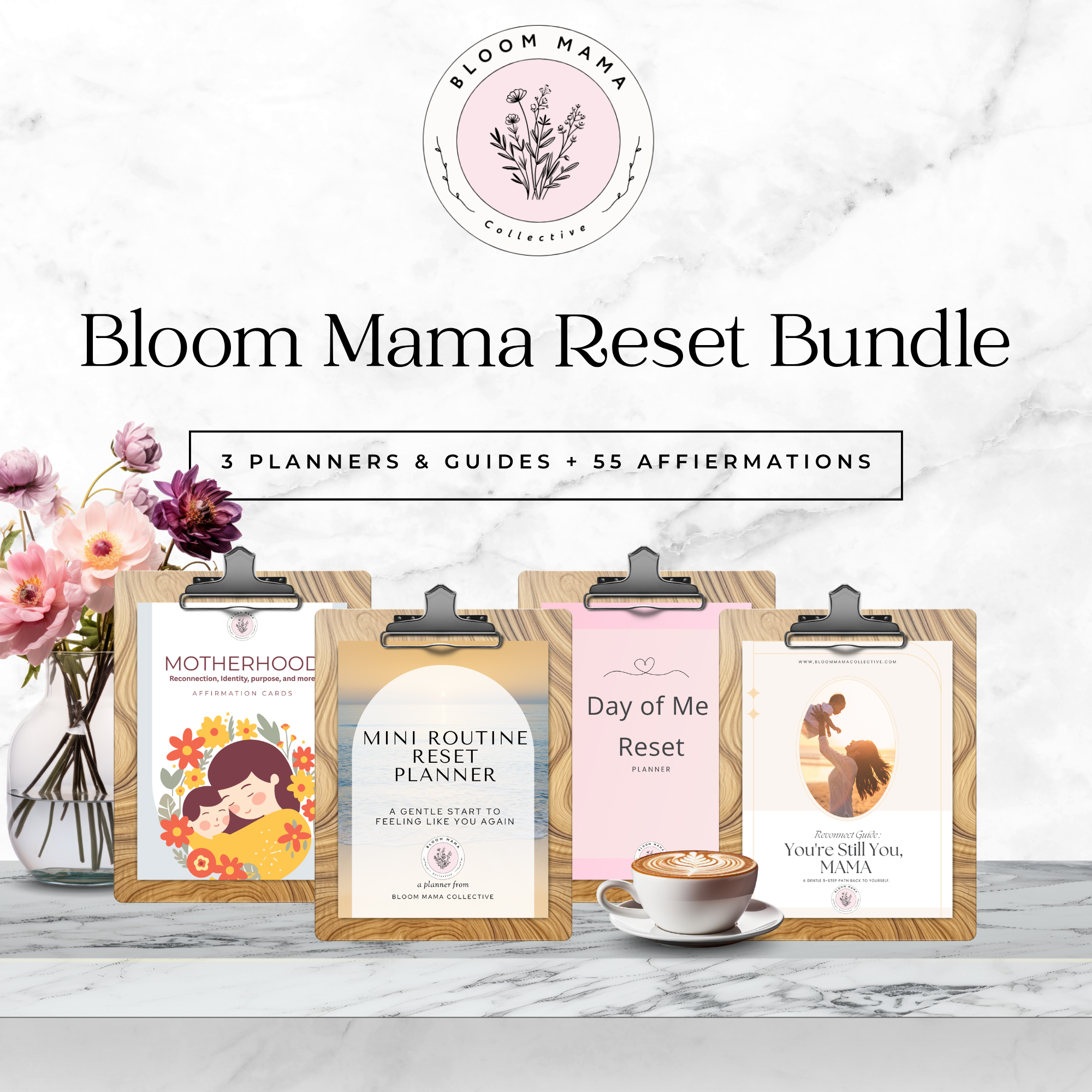
Small pockets of time can be enough to reconnect with yourself, and these ideas fit into a busy day.
| Pocket of time | Example | Why it helps |
|---|---|---|
| Before the kids wake | Sip your coffee in silence for 10 minutes | Gives you quiet before demands start |
| After dinner | Take a five-minute walk around the block | Resets your body and mind |
| While the bath runs | Read one page of a book | Keeps a reading habit alive |
| Before bed | Write three sentences in a journal | Ends the day with reflection |
Step 2: Reconnect With Interests and Personal Goals
Your interests did not disappear when you became a mother. They may just need a new place in your week. Here is a stage-aware way to reconnect.
Start with one interest you miss. It could be painting, running, cooking, reading, or learning a new skill. Then ask: what does a small version of this look like right now, given my current stage?
Stage-specific starting points:
- Pregnancy and newborn (0-6 months): Your time and energy are not your own. Aim for micro-doses, 10 minutes of reading before bed, listening to a podcast while feeding, or one weekly walk with a friend. Do not try to build a new skill now. Focus on keeping one thread alive.
- Toddler and preschool (6 months-4 years): Predictability helps. Pick one 30-minute block per week that is yours, and put it on the calendar. Trade childcare with another mother for a standing hour. Choose interests that can be done in short bursts, sketching, journaling, a short online course.
- School-age and beyond (5+ years): You may have more predictable windows. This is the season to join a class, start a weekly hobby group, or set a monthly goal. Protect the time by treating it as a non-negotiable appointment.
Set one small personal goal each month. Examples: finish a short book, complete a beginner course, run a 5K, or try one new recipe per week. Progress does not need to be fast. Small steps still count.
Share your goal with a friend who will check in. Accountability turns a vague intention into a real plan. A simple text, 'Did you do your 30 minutes this week?', is often enough.
Watch out: The biggest trap is waiting for the 'right time' when you will have more energy or fewer demands. That time rarely arrives. Start with the smallest possible version now, even if it feels almost too small to count.
Personal goals help you remember that you are more than a caregiver. They also give your children a model of a mother who has interests and pursuits of her own. Reconnecting does not require hours. It requires one honest choice and a little protection.
Step 3: Share the Invisible Load of Motherhood
Much of motherhood is invisible work. You track appointments, plan meals, remember birthdays, notice when supplies run low, and anticipate what everyone needs before they ask. This mental load can drain your energy and leave little room for yourself. Here is a concrete way to start.
First, make the invisible visible. For one week, keep a running list of every task you handle, not just the physical chores but the thinking work: remembering, planning, noticing, deciding. Most mothers are surprised by how long the list is.
Second, sort tasks into three buckets:
- Hand off completely, tasks someone else can own end-to-end (e.g., scheduling dentist appointments, managing school forms, planning one weeknight dinner)
- Share the thinking, tasks where you keep doing the physical work but someone else holds the mental checklist (e.g., partner tracks household supplies and adds them to the grocery list)
- Let go, tasks where your standard is higher than it needs to be (e.g., folded laundry, matching socks, elaborate birthday parties)
Third, have the conversation. Many partners want to help but do not know where to begin. Try these prompts:
- 'I am carrying most of the planning and remembering in our home. I need you to own [specific task] completely, including noticing when it needs to be done.'
- 'When I ask for help, I am not asking you to do me a favor. I am asking you to share the responsibility.'
- 'Let's pick three things you will take over this month. I will not remind you. If something slips, we will problem-solve together instead of me taking it back.'
Watch out: The most common failure is taking the task back the first time it is done differently or late. If you reclaim it, the load returns to you. Agree in advance that imperfect execution is part of the learning curve.
Fourth, revisit monthly. A short check-in, 'What is working? What feels heavy? What needs to shift?', prevents the load from creeping back. This is not a one-time conversation. It is a rhythm.
Sharing the load takes honesty and practice. Many partners genuinely do not see the invisible work until it is named. A simple, direct talk can change how your home runs, and give you back the energy to be yourself.
Step 4: Ground Your Identity in God's Truth Through Prayer
Many Christian mothers find that their identity feels most secure when it is rooted in God. Your worth does not depend on how much you accomplish or how well your house looks.
Try a short daily prayer practice:
- Read one verse about who God says you are
- Pray and name one area where you feel stretched
- Ask God to show you one small way to rest in Him today
- Write down what you sense He is saying
Prayer does not have to be long or polished. Honest words are enough. Over time, this practice can steady you when the world asks you to become someone new every day.
The Journals & Devotionals collection offers faith-filled reflection tools to support this step. Explore them at https://www.bloommamacollective.com/collections/journals-devotionals.
Your Next Step: Begin Your Identity Reset This Week
You do not have to fix everything at once. Choose one step from this article and start there. Protect a small pocket of time. Name one lost interest. Share one task. Pray one honest prayer.
If you want a gentle place to begin, the free 5-day mom reset can walk you through the first week at no cost. Get it here: https://www.bloommamacollective.com/pages/freebies.
Bloom Mama Collective created these tools to help you find yourself again in motherhood. Start your reset today and see what grows.
Frequently Asked Questions
How do you not lose yourself in motherhood?
Losing yourself in motherhood usually happens gradually, through many small surrenders of time, interests, and friendships. Protecting even ten minutes a day for something that belongs only to you helps. Keep one personal interest active, ask for help with a specific task each week, and revisit a reflection prompt when you feel invisible. Your identity does not disappear when you become a mother; it changes shape and needs intentional space to grow again.
What is the invisible load of motherhood?
The invisible load of motherhood refers to the mental work of tracking, planning, and remembering everything a household needs, such as appointments, groceries, school forms, and birthdays. It often goes unnoticed and unshared even when other tasks are divided. Naming this load out loud with a partner, and listing the tasks you carry each week, is a practical first step toward sharing it more fairly.
What is matrescence, and how can it affect your sense of identity?
Matrescence is the term for the profound developmental transition a woman goes through when she becomes a mother, comparable to adolescence in its scale of change. It can affect your sense of self, relationships, priorities, and body. Recognizing that this shift is normal and expected can ease self-judgment and give you permission to rebuild your identity gradually rather than expecting to feel like your old self right away.
How can I make time for myself as a mom?
Start with small, realistic windows rather than waiting for a full day off. A five-minute prayer during a morning routine, a short walk, or a reflection page in a planner can count. Schedule these moments the way you would schedule an appointment, and tell your household when you are unavailable. Consistency matters more than length, and the Bloom Mama Reset Bundle offers printable planners designed for these gentle daily resets.


